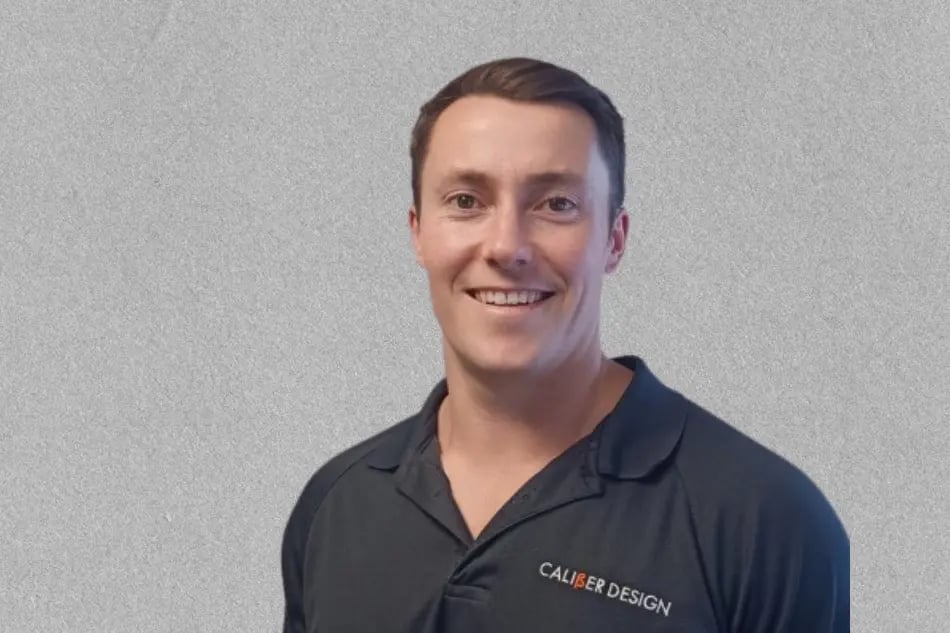
For mechanical engineer Tim Greene , stepping into the CEO role at Caliber Design meant not only leading the business day-to-day, but also learning how to operate effectively at board level.
After completing Icehouse’s Smart Governance Programme, Tim says the biggest change has been the confidence to keep the board on track, remove ambiguity and ultimately create a better structure for the Caliber Design team. By separating governance from management, clarifying decision-making, and focusing on long-term resilience, the business is not only running more smoothly now, but planning more strategically about its future.
Q: You stepped into a business that already had governance structures in place. What needed to change?
Tim Greene:
Yes there was a structure, but we’re in that transition from founder-led to management-led. For {Commercial Manager} James and me, it was important to really understand what it truly means to move from being a manager to being a director.
You can inherit structures, but until you understand why they exist, it’s hard to use them properly. The course helped us identify gaps, update what we had, and take a fresh look at our systems.
Q: What did that transition look like?
Tim Greene:
I became CEO two years ago, and our founder is still involved, but more in an advisory role. I also stepped into a director role this year.
What I didn’t fully appreciate before is how different those roles are. When your board is made up of people in the management team, it’s very easy for board meetings to just become extended management meetings.
That’s what we were guilty of. We’d meet monthly, but governance conversations were mixed in with operational ones. Now, we’re much clearer on the difference.
Q: How has the Programme changed the way you show up in the boardroom?
It’s made me much more deliberate.
Now, when I go into a board meeting or when I write a board report, I’m very clear on what decisions I need. It’s easy to spend months discussing things without actually deciding anything.
As CEO, being clear about what I need from the board makes everything easier. You have the right conversations, make decisions, and move forward.
Q: Has it changed your confidence as a CEO?
Tim Greene:
Definitely. One of the biggest shifts is having the confidence to say, “That’s a management decision.”
Boards can have opinions on everything, but not everything belongs at board level. Before, there was a risk of management by committee. Now I can park things and say, “I’ll come back with a decision.”
It works both ways too. Some decisions, like for example, the structure of our senior leadership team clearly belong at board level. We’re much better at recognising that now.
Q: What are some tangible changes in how decisions are made?
Risk is a big one.
At a management level, you’re focused on this week or next month. At a governance level, you’re thinking about the next five years, for example, what happens if things go wrong or how the business will survive a downturn.
We’re also having much clearer conversations about shareholders. With founders potentially exiting and a younger management team coming through, having a clear shareholder roadmap is critical. Otherwise, it becomes the elephant in the room.
Q: What would you say to other businesses putting governance in the “maybe later” file?
Tim Greene:
There’s always an issue of the day. You can always stay stuck in operational conversations.
But governance is what prepares you for uncertainty, whether that’s something like COVID, fuel or market shocks, or losing a key team member. If you’ve already thought about risk and contingency, you’ve got something to fall back on.
When things go wrong and they will, it’s hard enough to cope without being unprepared.
Q: How would you describe decision-making before and after the Smart Governance Programme?
Tim Greene:
We’re much more cohesive as a board now.
For us, the big challenge is managing that founder-to-management transition smoothly. The Smart Governance Programme helped drive the right conversations to make that happen.
It’s not just about structure, it’s about alignment.
Q: Has the wider team felt the impact?
Absolutely.
There’s nothing worse than leaders not being aligned. If the founder is saying one thing and the CEO another, it’s frustrating and disempowering for the team.
Now, because we’re clearer at board level, we can make two or three key decisions each month and give really clear direction. That lets the team get on with their work without things dragging on.
Q: How valuable was the Icehouse group learning environment?
Tim Greene:
That’s always one of the most valuable parts of an Icehouse programme for me. Seeing how other businesses approach governance and realising there’s no one-size-fits-all.
It also creates space for conversations you just don’t have in the office. When you’re out of your normal environment and exposed to new ideas, it sparks different thinking.
I’ve done the Owner Manager Programme as well so I know the value of keeping in touch with others outside my own industry and I do reach out to facilitator Derek Young – he’s always ready to respond and help.
Sound like something that might be of value to you? Find out more about our Smart Governance Programme here.